To measure the viability and lived reality of the Visitation charism in Visitation schools through a cyclical Salesian Assessment built on the Six Goals of Educating the Mind and Heart in the Visitation Tradition. Every five years, Visitation schools in the United States participate in a Salesian Assessment conducted by the national VSN for the Second Federation of the Order of the Visitation of Holy Mary. Its purpose is to measure the degree to which the Salesian mission is reflected in school policies, practices, and traditions so as to ensure the fulfillment of the mission to educate the mind and heart in the Visitation tradition.
Salesian Assessment History
In 2005, with Sr. Mary Berchmans Hannan, VHM, serving as National Director, the VSN created a Salesian Assessment Tool to measure the Six Goals articulated in Educating the Mind and Heart in the Visitation Tradition. The assessment process began in 2007 and since then, there have been three full cycles of Salesian assessments.
Salesian Assessment Purpose
The Salesian Assessment assists in ensuring the integration of the Salesian charism in all aspects of school life. More specifically, it will measure the degree to which the school’s mission is reflected in its policies and traditions. The conversations around the charism will assist Visitation communities to grow personally and professionally in their understanding of Salesian spirituality.
This assessment process creates a forum in which all constituencies—administrators, teachers, staff, students, Board members, parents, and alumni discover new ways to collaborate and establish ongoing reflection on the values inherent in a Visitation education. Each member of the community needs to feel that they have a place in the legacy of the school, that their voice is important and that what they want to express will be heard. The conversations around the charism encourage community members to grow both personally and professionally in their understanding of Salesian Spirituality.
Salesian Assessment Process
The assessment process allows each Visitation School an opportunity to reflect on how well the community lives the Salesian spirit and specifically how well the principles contained in Educating the Mind and Heart in the Visitation Tradition permeate the school environment. The Self-Study process is designed to encourage dialogue among the school’s constituents as they become more familiar with the beauty and strength of the Visitation Charism and provide them with opportunities to share successes, challenges, and plans for the future.
Upon the completion of the self study, a committee from the National Salesian Network will visit the school (two to three days in length). The committee will view this visit as an opportunity to have conversations about how well the school is integrating the values of a Visitation education in its everyday life. It will also be a time of prayerful celebration of the gift of the Visitation charism and a time for the school community to recommit themselves to the mission of furthering the blessings of this charism in their professional lives.
After the Committee’s visit, a report will be generated for the school which will reflect the Committee’s observations and action plans to be implemented throughout the five-year cycle.
Assessment Cycle
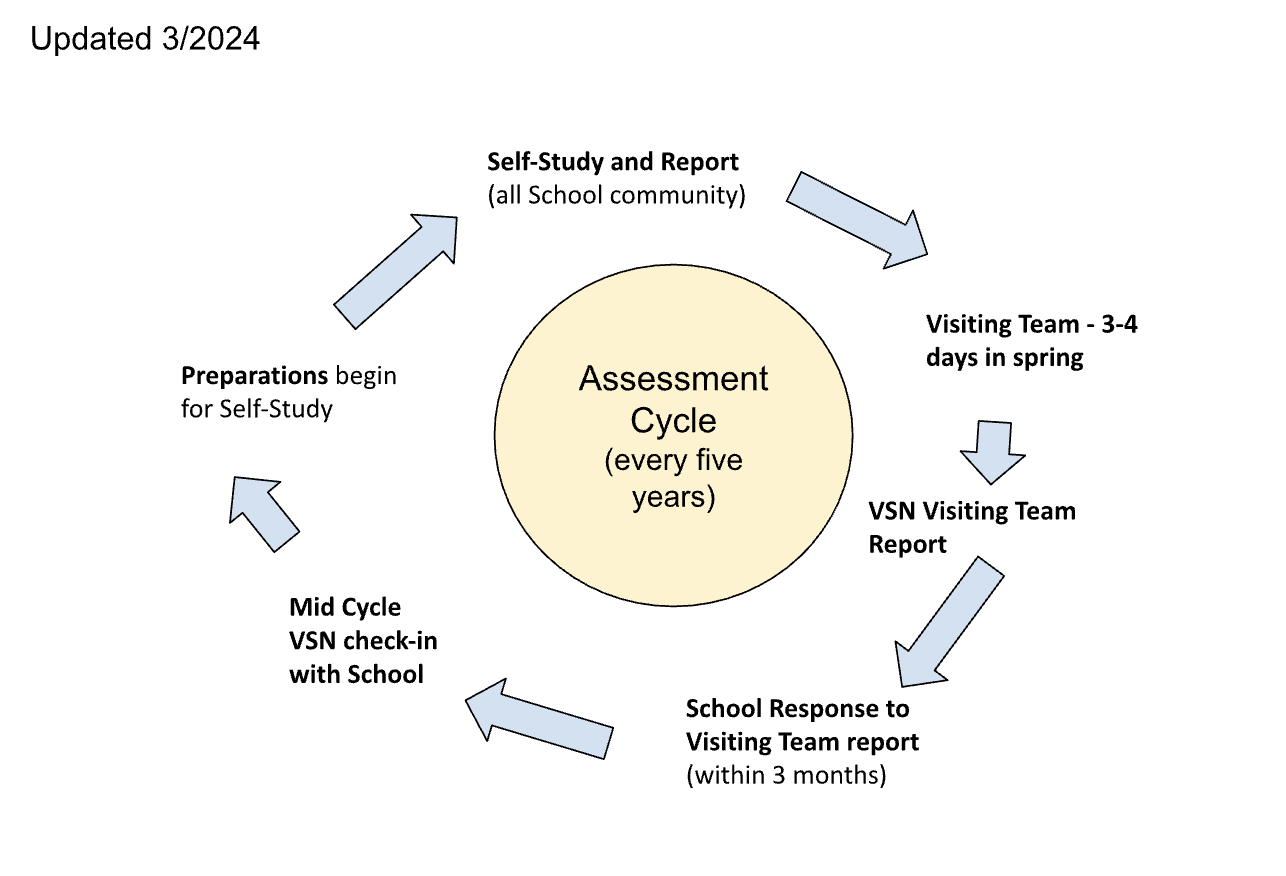
Visitation’s Salesian Assessment Process follows a five-year cycle designed to support each school in fulfilling its Salesian mission.
Once during each cycle, the school conducts a comprehensive Self-Study involving all school employees and key stakeholders. During March of the Self-Study year, the school hosts a visiting team. The visiting team confirms the school’s current practices and uses the Self-Study, together with on-the-ground observations, small group discussions, and previous experience, to commend the school for its strengths, work through challenges, and make recommendations for future plans and priorities. This method of assessment assures the integration of the Salesian charism in all aspects of school life. More specifically, it measures the degree to which the school’s mission is reflected in its policies, practices, and traditions.
Throughout the cycle, the school implements its plans for school improvement and communicates regularly about its status with the National Salesian Network Director.
 The Visitation Salesian Network of Schools