
The Foundation of the Visitation Order in Annecy France, 1610
The story of the Visitation Order begins with the personal stories of Francis de Sales and Jane de Chantal. They shared a dream of starting a congregation for religious women that would be unlike any other. On June 6, 1610, that dream became a reality with the foundation of the Order of the Visitation of Holy Mary. On that day, Jane de Chantal and two companions, Marie-Jacqueline Favre and Jeanne Charlotte de Brechard, moved into the Gallery House in Annecy, the first Monastery of the Visitation. The historical Gallery House at Annecy remains to this day. Francis and Jane envisioned a religious community of Sisters who would live their lives without the customary austerities that were part and parcel of religious orders at that time. The Visitation was intended to attract women of various ages and stations in life, including some who would have been refused admittance into other orders of the day because of age or physical condition. Francis and Jane chose the name of the Visitation to honor the holy friendship that Mary and Elizabeth showed to one another, bringing Christ to and recognizing Him in one another, and to focus the type of sacrifice of one’s will to the known will of God, just as Mary said yes to the angel Gabriel’s invitation. Mary further demonstrated her sacrifice to God’s will when she responded to the knowledge of her cousin’s pregnancy by traveling in order to support Elizabeth.
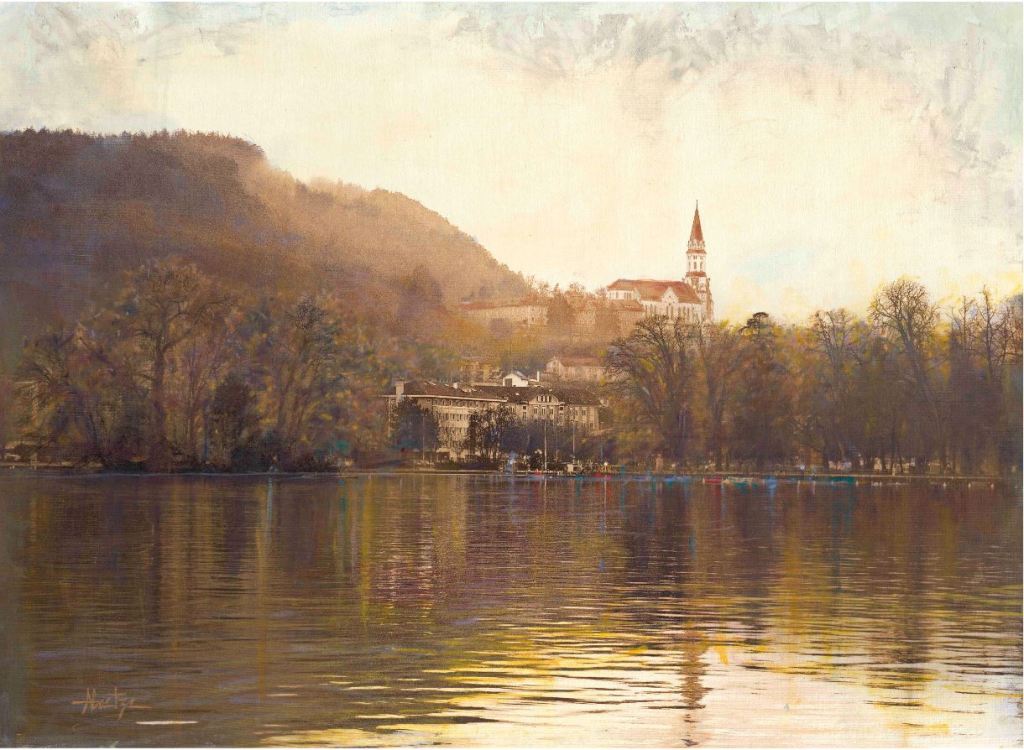
The life and routine of the Visitation Sisters was simplified, and prayer schedules were less rigorous than those of their religious contemporaries. Francis de Sales often said, “Let your feet be well shod but your hearts stripped bare.” His vision for the Visitation was to encourage an interior discipline of the heart rather than physical austerities. Jane and her companions made their first vows on June 6, 1611, a year after the foundation of the Visitation. Initially, the Sisters undertook a ministry of visiting the sick. Although Francis and Jane saw this ministry as part of a Visitation Sisters’ work, it was not destined to be so.
At the time of the second foundation, at Lyons, the Bishop of Lyons demanded the enclosure mandated by the Council of Trent (1545-1563). This concession greatly saddened Francis de Sales. He did not believe that enclosure was necessary for the attainment of holiness. Nevertheless, he acquiesced so that the Order could flourish beyond Annecy, and in 1615 the monastery at Lyons was established with papal enclosure.
By 1612, the community at the Gallery House had grown so large that a move was necessary. In 1616 a monastery was established in Moulins. In 1618, foundations began in Paris, Grenoble, and Bourges. Often, a monastery was founded with limited finances; in some cases, the Sisters had barely enough food. Each monastery was begun, however, with a complete and unfailing trust in Divine Providence and without exception, the Sisters’ basic needs were met.
The Visitation monasteries did not escape serious hardships. In 1628, many members lost their lives in an outbreak of the Plague. Jane wrote to the various houses and their superiors to give them courage. The Plague attacked the city of Annecy from 1629 to 1630. Jane never lost her sense of charity through it all. She was an overwhelming source of inspiration and a great example to her spiritual daughters. In the mid-1630s, Jane received requests that foundations be made beyond the borders of Savoy and France, to Poland, Switzerland, and Italy. In 1637, Jane mourned the death of her first companions at the Gallery House, who had shared with her the sweetness and the burden of being superiors of various foundations. Jane herself survived them by only a few years.
Jane died in 1641, nineteen years after the death of Francis. During those nineteen years, she had continued to establish new foundations and saw that the dream she and Francis had nurtured was brought to fruition. Jane de Chantal may not have realized how her congregation would expand or how quickly. At the time of her death, there were 80 monasteries, each of which she had herself established or had helped found. She spent the later years of her life visiting her monasteries and handling administrative concerns. Biographical sources indicate that what Jane wanted most was to be able to spend her time in anonymity, leading the simple life of an ordinary contemplative Sister, a desire that she would never experience fully. Throughout her life, Jane was almost constantly the superior of one monastery or another. At times, one house would elect her superior just as she completed a term at another.
However, the story of the Visitation order does not end with the death of St. Jane de Chantal, for the Visitation Order is now over 400 years old.
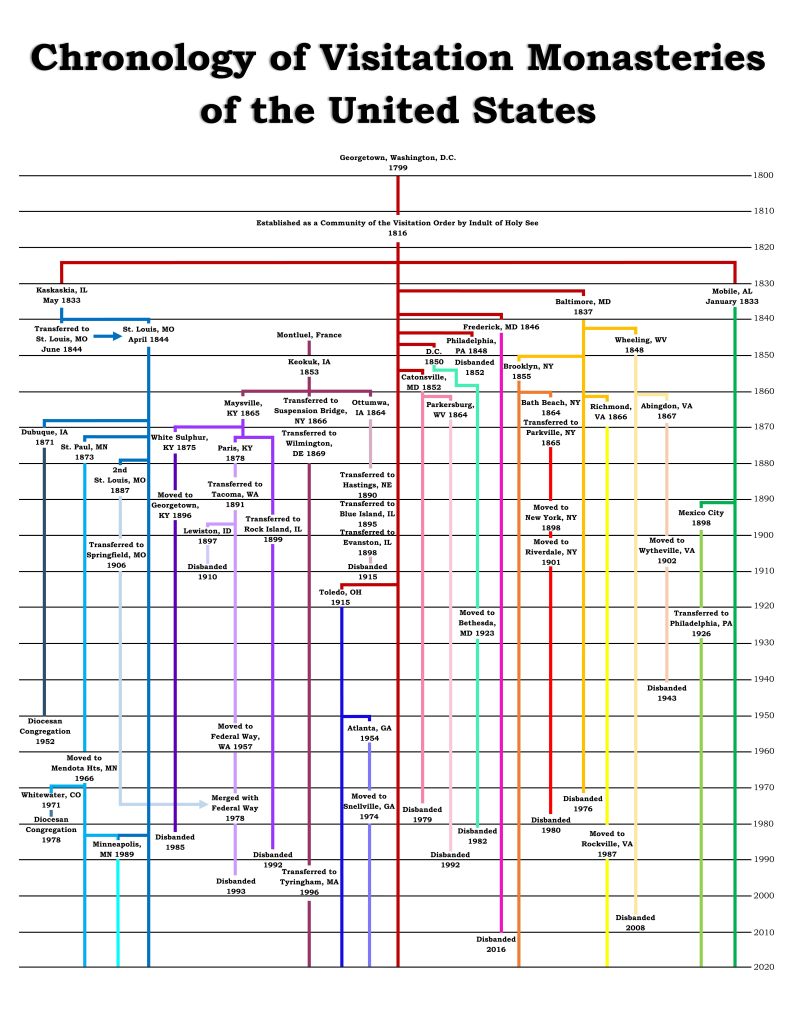
The Visitation Order in the United States Today
Federations serve to strengthen the bond of love among the monasteries by providing mutual aid and ensuring fidelity to the charism of the Visitation. There are approximately 17 federations of Visitation nuns in the world with two in the United States.
Five monastic communities belong to the First Federation in the United States:
- Visitation Monastery, Mobile Alabama
- Visitation Monastery, Rockville, Virginia
- Visitation Monastery, Snellville, Georgia
- Visitation Monastery, Toledo, Ohio
- Visitation Monastery, Tyringham, Massachusetts
Three monastic communities belong to the Second Federation in the United States:
 The Visitation Salesian Network of Schools